Woven Wealth: How Fine Carpets Are Earning a Place Alongside Art and Antiques in Hamptons Estate Portfolios
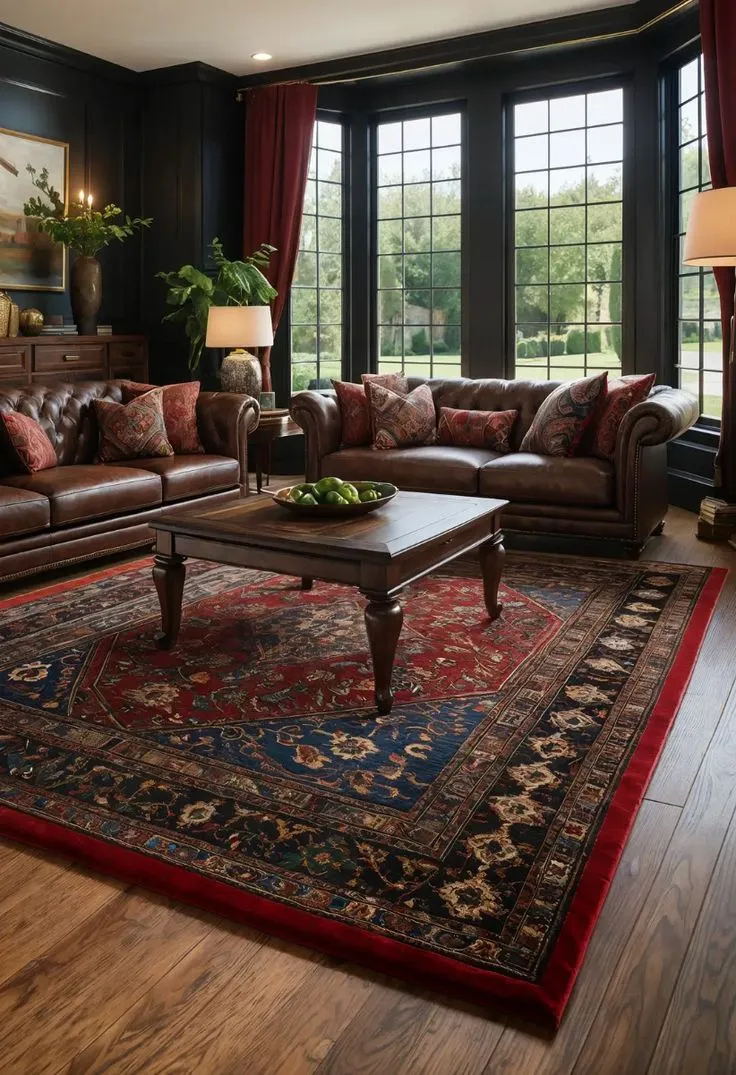
Photo: luxury hand-knotted Persian carpet elegant estate living room Hamptons interior, via i.pinimg.com
For generations, the most discerning collectors have understood that wealth is not confined to vaults and auction houses. It lives, quite literally, underfoot. In the grand estates of East Hampton, Bridgehampton, and Southampton, a quiet reappraisal is underway — one in which the finest floor coverings are being evaluated not merely as decorative choices, but as durable financial assets worthy of the same careful consideration afforded to museum-quality art and period antiques.
The numbers, increasingly, support this perspective.
The Tangible Value of Provenance
When estate appraisers assess a Hamptons property, their attention moves beyond square footage and waterfront access. Interior finishes — particularly authenticated, hand-knotted carpets from storied manufacturers — carry measurable weight in final valuations. A certified Savonnerie carpet, a documented Axminster commission, or a signed piece from a contemporary atelier such as Tai Ping or Edward Fields does not depreciate in the manner of mass-produced floor coverings. Quite the opposite: with proper stewardship, these pieces tend to appreciate alongside the broader luxury textile market.
"Buyers at the upper tier of the Hamptons market are sophisticated," notes one East End real estate professional familiar with estate transactions exceeding $20 million. "They recognize quality immediately, and they factor it into their offers. A hand-woven carpet with documented provenance in a principal reception room signals a level of curation that elevates the entire property."
This is not anecdotal. According to luxury property analysts who monitor the North Fork and South Fork markets, homes presenting with cohesive, high-end interior programs — including fine carpeting, bespoke millwork, and curated art collections — command premiums of between eight and fifteen percent over comparable properties with conventional finishes.
Heritage Collections as Collectible Assets
The analogy to art collecting is instructive. Just as a Basquiat canvas purchased in the 1990s has outpaced inflation many times over, a hand-knotted carpet from a celebrated weaving atelier, acquired thoughtfully and maintained with care, can represent a meaningful store of value.
Consider the market for antique Persian and Caucasian carpets. Christie's, Sotheby's, and Bonhams regularly feature such pieces in their decorative arts auctions, where examples in excellent condition routinely achieve six-figure results. A 19th-century Fereghan Sarouk or a finely knotted Tabriz medallion carpet, properly authenticated and conserved, belongs to the same conversation as period furniture and Old Master drawings.
Among contemporary production, certain manufacturers have cultivated the kind of institutional reputation that sustains long-term value. Companies with century-long histories of royal and institutional commissions — Axminster Carpets in England, Brintons with its documented heritage, or the Tibetan workshops producing for designers of international stature — produce pieces that collectors and estate buyers regard as legitimate acquisitions rather than mere furnishings.
For Hamptons homeowners building or refining an estate, the strategic acquisition of such pieces represents a form of diversification: tangible assets that beautify living spaces while retaining, and often growing, their monetary worth.
The Authentication Imperative
As with any collectible category, documentation is everything. A carpet without provenance is a carpet without a story — and without a story, its investment potential diminishes considerably. Savvy buyers insist on certificates of origin, weaver documentation, and, where applicable, records of prior ownership or exhibition.
Reputable flooring specialists operating in the luxury market maintain relationships with independent textile appraisers who can provide formal valuations for insurance, estate planning, and resale purposes. At Hamptons Carpet & Co., clients acquiring investment-grade pieces are encouraged to retain all original documentation, commission professional photography upon installation, and schedule periodic appraisals — particularly following significant movements in the broader luxury goods market.
This documentation also serves a practical estate-planning function. Carpets of significant value should appear in household inventories, be covered under fine arts insurance riders, and be accounted for explicitly in trust and estate documents. The failure to do so has resulted, in numerous high-profile estate settlements, in these assets being undervalued or overlooked entirely.
The Hamptons Market: A Unique Confluence of Factors
Few residential markets in the United States present the same alignment of conditions that make fine carpet acquisition so compelling on the East End of Long Island. The concentration of ultra-high-net-worth buyers, the prevalence of architecturally significant properties, and the cultural premium placed on sophisticated interior programs create an environment in which quality is both recognized and rewarded.
The seasonal nature of Hamptons residency also plays a role. Many estate owners occupy their properties for a portion of the year, reducing wear on fine carpets and extending their useful life considerably. Combined with the salt-air environment — which, when properly managed through climate control and professional maintenance, poses less threat to interior textiles than commonly assumed — this usage pattern is conducive to the long-term preservation of value.
Furthermore, the Hamptons buyer demographic skews toward individuals with existing experience in collecting. These are homeowners who understand the relationship between scarcity, provenance, and value. They are not purchasing carpets; they are acquiring pieces.
Building a Floor-Level Collection
For those approaching fine carpets as an investment category for the first time, a few principles merit consideration.
Begin with authentication. Work exclusively with dealers and design professionals who can provide verifiable provenance documentation. The luxury flooring market, like any collectible market, is not without its irregularities.
Prioritize rarity. Limited-edition atelier commissions, discontinued colorways from heritage manufacturers, and pieces with documented exhibition histories carry the greatest long-term value potential.
Invest in maintenance. The single greatest threat to a carpet's value is neglect. Professional cleaning, appropriate underlayment, UV protection, and climate-controlled storage during periods of non-use are not optional expenditures — they are the cost of protecting a significant asset.
Think architecturally. The most valuable carpet acquisitions are those that were commissioned or selected in dialogue with the architecture of the space they inhabit. Custom pieces designed for specific rooms carry a narrative that generic acquisitions cannot replicate.
The floor beneath one's feet has long been among the most overlooked surfaces in the vocabulary of luxury living. In the Hamptons, where every detail is subject to the scrutiny of an exceptionally discerning audience, that oversight is becoming increasingly rare — and increasingly costly to those who persist in it.