Floors in Motion: The Affluent Hamptons Set Embracing Luxury Carpets as Living Investments
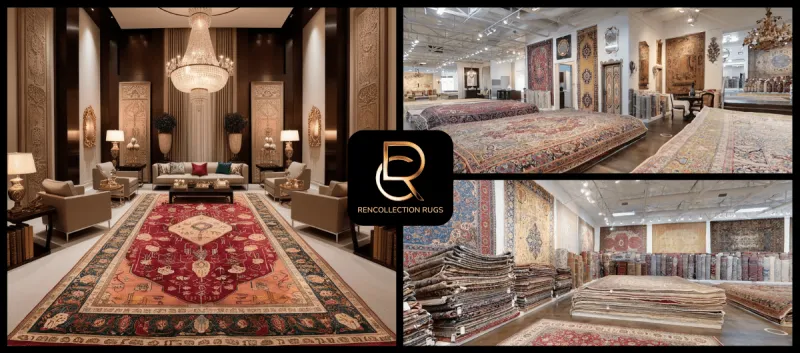
Photo: luxury antique carpet auction house bidding elegant interior, via rencollection.com
Not long ago, the idea of selling a luxury carpet would have struck most Hamptons homeowners as faintly eccentric — the province of estate liquidations and downsizing, not of deliberate portfolio strategy. That perception is changing, and changing quickly. Among a discerning cohort of high-net-worth residents, the rotation of fine floor coverings through auction platforms and private resale channels has become not merely acceptable but actively fashionable — a signal, in fact, of a particularly sophisticated relationship with the objects that furnish one's life.
The analogy to fine wine is one that participants in this emerging market reach for readily. Like a well-cellared Burgundy, a significant carpet — properly acquired, meticulously maintained, and sold at the right moment to the right buyer — can yield returns that compare favorably with more conventional asset classes, while also providing years of aesthetic pleasure in the interim. The difference, of course, is that one walks on it.
The Investment Thesis, Stated Plainly
The case for treating luxury carpets as investment-grade assets rests on several converging factors. First, genuine rarity: a hand-knotted antique of documented provenance, or a contemporary limited-edition piece from a prestigious atelier, exists in finite supply. Unlike equities or real estate, its quantity cannot be increased to meet demand. Second, condition sensitivity: a piece that has been properly cleaned, stored, and displayed will hold its value in ways that a neglected example simply cannot. Third, and perhaps most compellingly, market momentum: the past decade has seen sustained growth in collector interest for significant textiles, with major auction houses reporting increasingly competitive bidding for exceptional lots.
For Hamptons homeowners already accustomed to thinking in terms of art portfolios and alternative investments, the extension of that logic to floor coverings is not a large conceptual leap. It is, rather, a natural evolution — one that transforms the act of furnishing a home from a matter of pure expenditure into something more closely resembling curation with upside potential.
Where the Transactions Are Happening
The secondary market for luxury carpets operates across several distinct channels, each with its own characteristics and clientele. At the most visible end of the spectrum sit the major international auction houses, where significant antique and vintage pieces appear within dedicated textile sales or as part of broader decorative arts offerings. These venues provide the highest degree of public accountability — condition reports, provenance research, and competitive bidding that establishes transparent market value — but they also involve seller's commissions and timelines that do not suit every transaction.
For pieces that are exceptional but perhaps not of sufficient rarity to command the attention of a major house, a growing number of specialist platforms have emerged to fill the gap. Online marketplaces dedicated to high-end antique and vintage textiles, such as 1stDibs, now facilitate transactions at price points that would once have required a bricks-and-mortar gallery. Meanwhile, private dealers — often the same figures who supply the trade in the first instance — maintain discreet buy-sell operations that allow clients to liquidate pieces without the formality or publicity of a public sale.
Perhaps the most intriguing development is the rise of what might be termed the peer-to-peer collector network: informal channels through which Hamptons homeowners, connected through shared advisors, design professionals, or social circles, trade directly with one another. These transactions, invisible to any public record, are believed to account for a meaningful share of high-value carpet transfers in the region.
The Authentication Imperative
As the secondary market for luxury carpets has grown, so too has the scrutiny applied to the pieces moving through it. Authentication — always a consideration in the antique textile world — has become an increasingly formalized discipline, driven in part by the higher stakes that investment-grade valuations introduce.
For antique pieces, authentication typically involves a combination of physical analysis (fiber composition, dye chemistry, structural characteristics) and provenance documentation — the paper trail that traces a carpet's history through prior sales, collection records, and exhibition appearances. Specialist consultants with backgrounds in textile history and conservation science have built practices around this work, and their opinions carry significant weight in both private negotiations and auction house deliberations.
Contemporary luxury pieces present a different but equally important set of authentication challenges. As the resale value of limited-edition or commission pieces from prestigious ateliers has risen, so has the incentive to misrepresent provenance or production details. Certificates of authenticity, mill records, and designer documentation have all become standard expectations for serious buyers — and sellers who cannot produce them will find their asking prices discounted accordingly.
For Hamptons homeowners entering the resale market for the first time, working with a knowledgeable advisor — whether a trusted interior designer, a specialist dealer, or an independent authentication consultant — is not merely advisable. It is essential.
Maintenance as Value Preservation
Among the practical implications of treating carpets as investment assets, none is more consequential than the approach to ongoing care. A piece that has been improperly cleaned, exposed to prolonged direct sunlight, or stored in conditions of excessive humidity will arrive at resale in a condition that reflects those choices — and the market will price it accordingly.
Professional cleaning by specialists with experience in luxury textiles is the foundation of any value-preservation strategy. For coastal Hamptons properties, where salt air and humidity present particular challenges to natural fibers, this typically means more frequent professional attention than would be required in a drier, more temperate environment. Rotation programs — periodically repositioning a carpet within a room, or cycling pieces between different spaces in a residence — help to distribute wear evenly and protect against the localized fading that direct light exposure can produce.
Storage, for pieces not currently in use, requires controlled conditions: stable temperature, low humidity, protection from pests, and careful rolling (never folding) to prevent crease damage. These are not trivial considerations, and the cost of getting them right is modest in comparison to the value that attentive stewardship preserves.
The Curation Mindset
Underlying this entire phenomenon is a shift in how a certain kind of Hamptons homeowner conceives of their relationship to the objects in their homes. The permanence that once characterized luxury acquisition — the sense that a significant purchase was a final decision, a statement of settled taste — has given way to something more fluid and more dynamic. The finest homes, in this view, are not finished compositions but living collections, subject to ongoing refinement as the market evolves, as tastes develop, and as new opportunities present themselves.
For carpets, this means that the question is no longer simply which piece is right for a given room, but which piece is right for this room, at this moment, given what the market currently offers and what it may offer in the future. It is a more demanding posture, intellectually and logistically. But for those who embrace it, the rewards — aesthetic, financial, and otherwise — appear to be considerable.