The Floor Beneath the Price Tag: How Luxury Carpet Choices Shape Hamptons Estate Valuations
In a market where a view of Mecox Bay or a hedgerow-lined motor court can add seven figures to an asking price, it may seem counterintuitive to linger on the floor. Yet among the Hamptons' most seasoned real estate professionals, a quiet consensus has formed: the quality of a home's carpet and flooring selections functions as one of the most reliable proxies for the overall condition and character of an estate. When a prospective buyer steps across a hand-knotted Tibetan wool runner in a foyer, something registers — an impression of meticulous ownership that travels through every subsequent room.
"Buyers in this market are extraordinarily perceptive," says one prominent East Hampton broker who has represented estates well into the eight-figure range. "They may not be able to articulate exactly why a home feels different the moment they walk in, but premium flooring — particularly fine carpet — communicates a level of investment and intentionality that sets the tone for everything else they're about to see."
The Signal Value of Fine Flooring
In luxury real estate, condition and curation are inseparable. A home in which the owners invested in hand-loomed carpets from distinguished mills in Nepal, Morocco, or the English West Country sends a clear message to appraisers and buyers alike: no corners were cut. This signal effect is disproportionately powerful relative to the cost of the flooring itself.
Appraisers operating in the Hamptons and broader East End markets note that while carpets and rugs are not line-itemed in traditional appraisal methodology the way square footage or bathroom count might be, they factor meaningfully into the broader category of "quality of finishes" — a designation that can move comparable values by several percentage points. On a $4 million estate, that margin is not trivial.
The logic extends beyond aesthetics. A home that has been maintained with precision — where the carpets are not merely present but are genuinely fine, properly installed, and immaculately kept — implies that mechanical systems, structural elements, and exterior features have received the same attention. Buyers and their representatives read flooring as a kind of index of stewardship.
Which Choices Command the Greatest Returns
Not all carpet selections are created equal in the eyes of the market. According to brokers and staging consultants who work regularly with Hamptons sellers, certain categories of flooring consistently distinguish themselves at the point of sale.
Hand-knotted wool carpets — particularly those sourced from heritage producers in India, Afghanistan, or the United Kingdom — are regarded as the gold standard. Their density, durability, and visual complexity communicate craftsmanship in a way that machine-made alternatives simply cannot replicate. Custom-woven pieces commissioned specifically for a property's dimensions and palette carry additional cachet, implying that the home was designed as a unified whole rather than assembled from catalog selections.
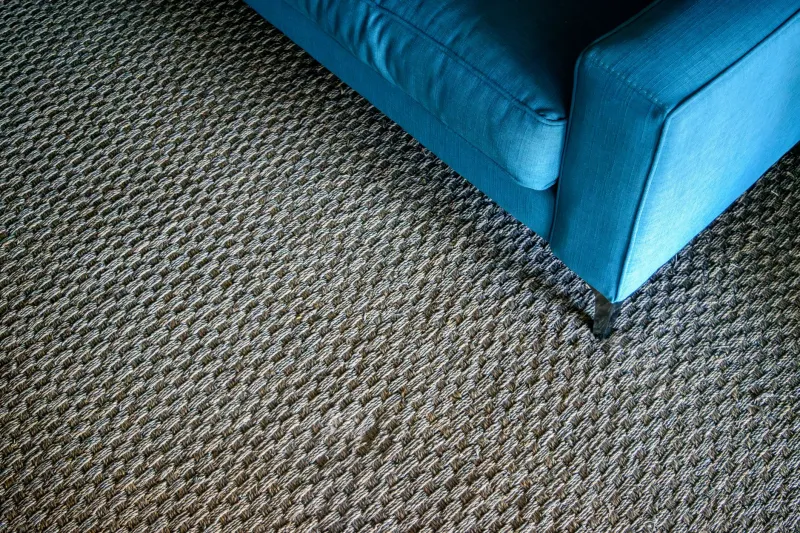
Sea-grass, sisal, and other natural fiber installations in informal spaces — mudrooms, pool houses, covered terraces — also register positively, provided they are sourced from premium suppliers and installed with the same precision as more formal interior carpets. The consistency of quality across every room, including those that might otherwise be treated as secondary, speaks volumes to the thorough buyer.
Conversely, brokers caution that worn, improperly maintained, or generically sourced carpets can actively suppress a property's perceived value. "I have seen a beautifully renovated kitchen lose its impact entirely because the adjacent living room carpet was tired," one Bridgehampton broker notes. "Buyers don't compartmentalize. They experience a home as a totality."
Case Studies From the East End
Several recent transactions on the East End illustrate the tangible impact of signature flooring decisions.
A Water Mill estate that changed hands in the past two years was notable among local brokers for the role its carpet program played in the marketing narrative. The sellers had, over the course of their ownership, replaced all principal room flooring with custom-commissioned pieces from a respected New York design atelier, incorporating hand-tufted wool in a palette drawn directly from the property's garden views. During showings, the carpets became a consistent point of conversation — buyers asked about them, photographed them, and referenced them in offer correspondence. The property ultimately sold at a figure that exceeded initial appraisal estimates, with brokers on both sides of the transaction acknowledging the flooring as a contributing factor.
In a separate instance, a Southampton estate that had been on the market without success underwent a targeted refresh prior to relisting. Among the interventions recommended by the listing broker was the replacement of dated wall-to-wall carpeting in the primary suite and two guest rooms with hand-woven wool broadloom in a contemporary neutral. The relisting generated substantially stronger initial interest, and the property sold within sixty days — a meaningful improvement over its prior stagnation.
The Maintenance Dimension
Real estate professionals are equally attentive to the condition of existing carpets, not merely their provenance. A fine carpet that has been professionally maintained — cleaned on a proper schedule, protected from direct light, repaired with appropriate craft when damage occurs — retains its contribution to overall home value in a way that a neglected specimen, regardless of its original cost, cannot.
This is a distinction that Hamptons estate owners would do well to internalize well in advance of any sale. The investment in professional carpet care over the course of ownership is not merely a matter of aesthetic preservation; it is, in the most literal sense, a financial one. Buyers and their inspectors notice the difference between a carpet that has been conscientiously maintained and one that has simply survived.
A Considered Investment, Not a Cosmetic One
The broader lesson for Hamptons homeowners is that luxury carpet selection and maintenance should be understood as a component of estate stewardship rather than interior decoration alone. In a market where buyers are sophisticated, well-advised, and accustomed to comparing properties at the highest level of finish, flooring quality functions as a credible and durable signal of overall value.
For those preparing an estate for eventual sale — whether in two years or twenty — the decision to invest in genuinely fine carpet is one that tends to return more than its cost. The floor, it turns out, is not merely where a home begins. In the Hamptons market, it may well be where value is made.