The Acoustics of Elegance: How Luxury Carpets Are Redefining Sound in Hamptons Home Theaters and Listening Rooms
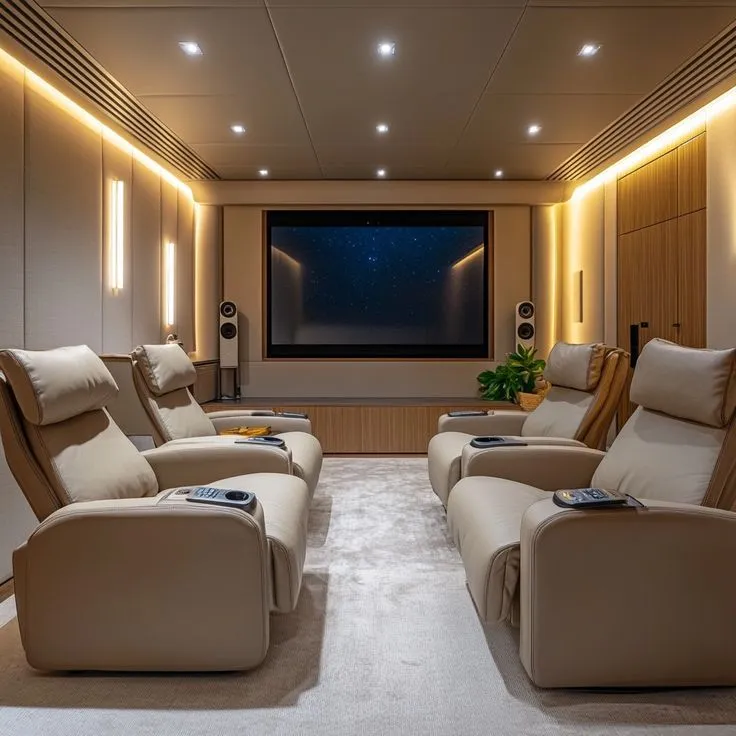
Photo: luxury home theater room with plush carpet and elegant interior design, via i.pinimg.com
There is a particular kind of silence that precedes great sound — a hush so complete, so deliberate, that the first note of music or the opening sequence of a film arrives with almost physical clarity. In the most distinguished Hamptons estates, that silence is not engineered solely by electronics. Increasingly, it begins underfoot.
Luxury carpets, long celebrated for their visual and tactile contributions to interior spaces, are now being recognized for an equally important attribute: their capacity to shape, absorb, and refine acoustic environments. For homeowners investing in private home theaters and dedicated listening rooms — spaces where the quality of sound is as consequential as the quality of design — the carpet selection has become a decision of genuine technical and aesthetic weight.
Sound as a Design Problem
To understand why flooring matters so profoundly in these spaces, one must first appreciate how sound behaves within an enclosed room. Audio engineers speak of a phenomenon known as acoustic flutter — the rapid, repeating echo that occurs when sound waves bounce between parallel hard surfaces. In rooms with stone, hardwood, or polished concrete floors, this effect can muddy dialogue, diffuse musical detail, and introduce a fatiguing brightness that no amplifier or equalizer can fully correct.
"Hard floors are essentially mirrors for sound," explains one East Hampton–based acoustic consultant who has designed listening environments for several prominent estate properties along Further Lane. "Every frequency that hits that surface bounces back into the room. You can spend a hundred thousand dollars on speakers and still have a mediocre listening experience if the floor isn't doing its part."
Carpet, by contrast, absorbs sound energy rather than reflecting it. The fibers interrupt the wave's path, converting acoustic energy into negligible amounts of heat and dramatically reducing the reverberation time — the measure of how long a sound lingers in a space after its source has ceased. The denser and deeper the pile, the more pronounced this effect becomes.
The Technical Hierarchy of Carpet Construction
Not all carpets perform equally in this regard, and the distinction between standard residential carpeting and the acoustically optimized luxury options available to discerning Hamptons homeowners is considerable.
Pile height and density are the primary variables. A high-density, cut-pile wool carpet with a substantial underlay will absorb a far broader range of frequencies than a low-pile flatweave, regardless of how beautiful the latter may be. For home theater applications, audio engineers typically recommend pile heights of three-quarters of an inch or greater, combined with a thick felt or rubber acoustic underlay that adds a secondary layer of absorption and decoupling from the subfloor.
Material composition also plays a meaningful role. Wool remains the gold standard — its natural crimp and cellular structure give it an absorption coefficient that synthetic fibers struggle to replicate. For clients who require both acoustic performance and the textural richness of natural materials, hand-knotted wool carpets from heritage weaving traditions offer an extraordinary confluence of technical function and artisanal provenance.
"We specify wool almost exclusively for our listening room projects," notes a Southampton interior designer whose firm has completed several high-profile audio-centric installations across the Hamptons. "It performs beautifully, it ages with tremendous grace, and it carries a visual warmth that simply cannot be replicated. In a room designed for an emotional experience, that warmth matters enormously."
Case Study: A Private Cinema in Water Mill
Among the more instructive examples of acoustically considered carpet selection in recent years is a private cinema completed at a Water Mill estate whose owner, a devoted cinephile, demanded both reference-quality audio and an interior that could hold its own against the property's broader design vocabulary — a refined blend of mid-century American furnishings and contemporary art.
The acoustic consultant and interior designer worked in close collaboration from the earliest stages of the project, treating the floor as a shared problem rather than a departmental boundary. The result was a custom-commissioned, hand-tufted wool carpet in a deep charcoal ground with a subtle geometric border, specified at a pile height of one inch and installed over a two-layer acoustic underlay system.
The impact on sound quality was measurable. Reverberation time in the room dropped to within the parameters considered ideal for cinema reproduction, and the consultant noted a particular improvement in the intelligibility of dialogue — often the first casualty of an acoustically underdeveloped room. The designer, for her part, was equally satisfied. "It became the visual anchor of the entire space," she recalls. "Everything else — the seating, the wall panels, the lighting — orbited around it."
The Listening Room: A Different Set of Demands
Dedicated music listening rooms present a slightly different acoustic brief. Where home theaters benefit from relatively high absorption to support the directional precision of multichannel audio, two-channel listening rooms for serious music reproduction often require a more nuanced balance — enough absorption to tame reflections without deadening the room to the point of sterility.
Several Hamptons audiophiles have worked with designers to achieve this balance through layered carpet solutions: a primary area carpet of substantial pile covering roughly two-thirds of the room's floor area, supplemented by smaller accent rugs positioned at acoustically strategic points. This approach also introduces visual complexity and the opportunity to incorporate pieces of genuine collector interest — antique Oushak carpets, vintage Scandinavian flatweaves, or contemporary hand-knotted works from emerging artisans.
"The best listening rooms I've worked on feel like they were designed by someone who loves both music and objects," observes one Bridgehampton-based designer. "The carpet isn't just performing a function. It's contributing to a room that feels considered, layered, and alive."
Maintenance and Longevity in High-Use Spaces
For all their acoustic and aesthetic virtues, luxury carpets in entertainment spaces require attentive maintenance protocols. Home theaters and listening rooms, by their nature, receive concentrated foot traffic and are frequently used during food and beverage service. Wool carpets in these environments benefit from regular professional cleaning — ideally on an annual cycle — and from prompt attention to any spills or soiling that might otherwise compromise both appearance and fiber integrity.
The use of high-quality underlays also bears consideration from a maintenance perspective: a well-specified underlay not only enhances acoustic performance but protects the carpet's backing from subfloor moisture and extends the useful life of the installation considerably. In the coastal Hamptons environment, where humidity levels can fluctuate significantly across seasons, this protection is more than incidental.
An Investment in Experience
The broader principle at work in these acoustically engineered interiors is one that resonates deeply with the philosophy of thoughtful luxury: that the finest environments are those in which every element has been selected with equal care, where function and beauty are not competing values but complementary ones.
For Hamptons homeowners who have invested substantially in the audio and visual technology of their entertainment spaces, the carpet beneath those systems represents not merely a finishing detail but a foundational component — one whose influence on the quality of the experience is as profound as any piece of equipment in the room. In the most refined homes, the floor does not merely support what happens above it. It shapes it.