From Greige to Sculpted Wool: Five Carpets That Ruled the Hamptons This Decade
Photo: Shixart1985, CC BY 2.0, via Wikimedia Commons
Trends in flooring do not announce themselves. They arrive quietly, in designer showrooms and architect specifications, and within a few seasons they are everywhere from Sagaponack to Amagansett. Looking back over the past decade of Hamptons interiors, five distinct carpet movements stand out — each a response to what came before, and each now yielding, in turn, to something new.
1. The Greige Sisal-Look Era (2015–2019)
No single texture defined the mid-decade Hamptons house more thoroughly than the greige sisal-look: a flat-woven, gray-beige natural fiber that promised coastal ease and architectural restraint in equal measure. It ruled because it was safe in the best sense — it receded, it photographed beautifully, and it paired effortlessly with the white-oak floors and slipcovered furnishings of the era.
The champions were the minimalist coastal designers, for whom texture was the only permissible form of ornament. But the look's weakness revealed itself over time: true sisal stains badly, and even its wool imitations offered little underfoot comfort. By decade's end, clients had begun asking, politely, for something softer.
What's replacing it: Textured wool loops in warm ivory and oat — the same visual restraint, with genuine comfort and resilience.
2. The Overdyed Vintage Revival (2016–2020)
For a brief, luminous window, every Hamptons renovation seemed to include an overdyed vintage rug — a faded antique Turkish or Persian piece re-dyed in muted slate, sage, or blush. It satisfied the era's hunger for patina and story while still honoring a restrained palette.
The movement was driven largely by the antique dealers-turned-consultants who populated the East End design scene, and by homeowners who wanted a floor with provenance rather than perfection. Its decline came from saturation: what once read as collected began to read as catalog.
What's replacing it: Original vintage and antique rugs, un-overdyed, celebrated for their wear rather than disguised by it.
3. The Broadloom Plush Revival (2019–2022)
When the pandemic turned second homes into first homes, priorities shifted overnight. The Hamptons house was no longer a summer stage; it was a year-round refuge. Demand for deep, plush, wall-to-wall comfort — particularly in bedrooms and media rooms — surged.
Dense cut-pile wools in warm neutrals dominated specifications during this period, and for good reason: nothing else delivered the same barefoot luxury. The style's vulnerability is its ubiquity, and designers are now tempering full-room plushness with pattern and contrast.
What's replacing it: Zoned comfort — plush where you stand, texture where you look.
4. The Bold Geometric Statement (2021–2023)
As interiors loosened, so did the floors. The early twenties brought a wave of graphic, geometric carpets — oversized lattices, abstract grids, and tonal checks — often in wool and bamboo silk. These were floors that participated in the room rather than disappearing beneath it.
The style suited the new maximalist-minimalism: rooms pared down in furniture but confident in pattern. Its limitation, designers note, is longevity. A bold geometric carpet is a commitment, and commitment fatigue is setting in.
What's replacing it: Sculptural, low-contrast patterning — carpets with dimension you feel more than see.
5. Sculpted Wool and the New Texturalism (2023–Present)
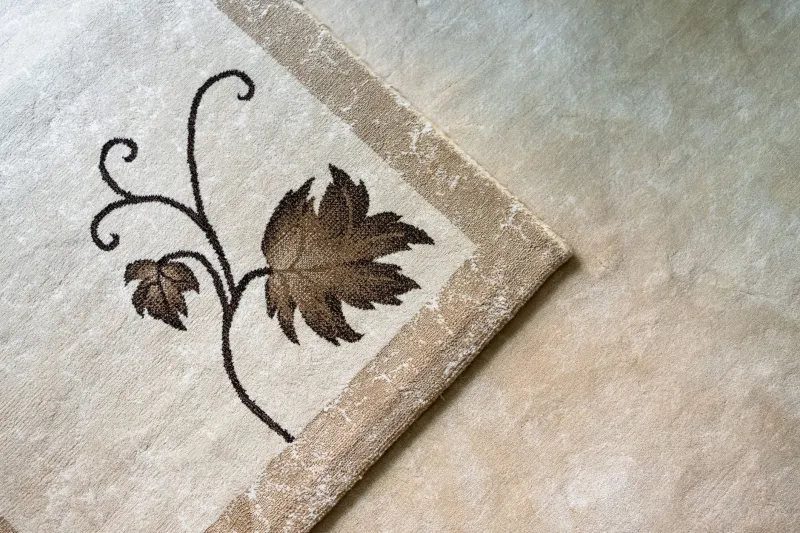
The current movement, and the one we believe will define the second half of the decade, is sculpted wool: carpets in which high and low pile, cut and loop, are combined to create relief — a floor that reads almost like a woven landscape. The palette has warmed too, moving from greige into clay, mushroom, and undyed natural tones.
This is the carpet as craft object, and it aligns with the broader shift toward heirloom-minded purchasing we have documented across Hamptons estates. These are floors bought to last generations, not seasons.
What comes next: Early signals point toward hand-tufted, small-batch commissions and bio-based fibers — floors with both a maker and a conscience.
Reading the Decade Forward
The through-line across all five movements is a steady migration from floor-as-backdrop to floor-as-subject. Hamptons homeowners once wanted their carpets invisible; now they want them intentional. For buyers planning their next installation, the wisest position is neither slavishly current nor defiantly retro — but grounded in fiber quality and construction that will outlast whichever movement follows.