The Point of No Return: Recognizing When a Beloved Carpet's Time Has Finally Come
There is a particular kind of grief reserved for the Hamptons homeowner who stands at the edge of a room and realizes, after years of careful stewardship, that the magnificent carpet beneath their feet has quietly, irrevocably changed. Not damaged in any dramatic sense. Not stained beyond recognition. Simply — and heartbreakingly — spent.
For those who have invested meaningfully in hand-knotted Persians, custom broadloom commissions, or antique Tibetan pieces woven decades before they were born, the question of replacement is rarely straightforward. It is, at its core, an exercise in honesty: the willingness to see what is actually there rather than what one wishes to see.
When Sentiment Clouds the View
Luxury carpet ownership in the Hamptons carries a weight that goes well beyond square footage and price per knot. These are pieces acquired on buying trips through Istanbul's Grand Bazaar, selected during private viewings at Manhattan auction houses, or commissioned through designers whose waiting lists stretch across years. They hold memory. They anchor rooms that have witnessed generations of family life.
It is precisely this emotional investment that makes the replacement decision so difficult — and so frequently delayed. Conservators who work with high-net-worth clients along the East End note that homeowners often arrive for consultations already knowing what they need to hear. The carpet has been living on borrowed time for two or three years, and the appointment is less about diagnosis than about permission.
"The hardest conversations are with clients who have inherited a piece," observes one textile conservator who has worked with several prominent Hamptons estates. "They feel a sense of obligation to the carpet that has nothing to do with its current condition. Letting go feels like betrayal."
Understanding this emotional dimension is the first step toward making a clear-eyed assessment.
Structural Signals That Cannot Be Ignored
Before any aesthetic judgment is rendered, a luxury carpet must first be evaluated on structural grounds. The most telling indicators are often invisible to the untrained eye but unmistakable once one knows where to look.
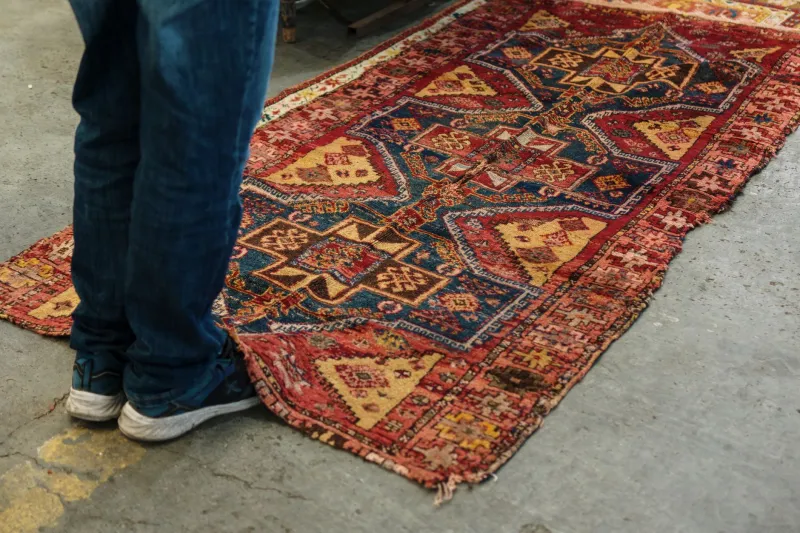
Foundation deterioration — the degradation of the warp and weft threads that form a carpet's internal skeleton — is among the most serious findings a conservator can deliver. When these foundational fibers have weakened to the point of brittleness, no surface restoration can address the underlying fragility. A carpet in this condition may look presentable from a standing distance, yet be genuinely hazardous underfoot, prone to tearing under ordinary foot traffic.
Pile loss beyond the recovery threshold presents a related challenge. Every luxury carpet loses pile over time; this is expected and, in many antique pieces, considered part of the textile's character. However, when pile loss becomes uneven — concentrated in high-traffic corridors, thresholds, or beneath furniture — the carpet begins to lose its visual coherence. Spot re-piling is possible in limited areas, but when the affected zones account for more than a third of the carpet's surface, the economics and aesthetics of repair rarely justify the investment.
Backing separation and dry rot are particularly common in coastal environments like the Hamptons, where humidity fluctuations place constant stress on natural fibers. A carpet whose backing has begun to separate from its pile layer is structurally compromised in ways that restoration cannot meaningfully reverse.
The Aesthetic Threshold
Beyond structural integrity lies a subtler but equally important consideration: whether a carpet continues to perform its essential design function within a room.
Luxury interiors are dynamic environments. Wall colors are refreshed. Furniture collections evolve. Art acquisitions shift the chromatic language of a space. A carpet that once anchored a room with authority may, over time, come to feel like a remnant from an earlier design chapter — present, but no longer purposeful.
This is not a failure of the carpet itself. It is simply the nature of living with beautiful things in spaces that continue to grow and change. Elite designers working in the Hamptons market frequently counsel clients to evaluate their statement carpets against the current room composition rather than the one that existed at the time of acquisition. A deep jewel-toned Sultanabad that once played brilliantly against a particular wall treatment may now compete awkwardly with an evolved palette.
When a carpet no longer contributes to a room's visual harmony — when it must be worked around rather than worked with — that is a significant signal worth taking seriously.
The Restoration Calculus
For those reluctant to part with a beloved piece, professional restoration remains a meaningful option, provided the carpet meets certain baseline criteria. Conservators generally assess three variables: the structural soundness of the foundation, the availability of period-appropriate repair materials, and the proportional cost of restoration relative to the carpet's appraised or sentimental value.
A well-preserved antique with minor localized damage and a sound foundation is an excellent restoration candidate. The investment is justified, the outcome is predictable, and the piece retains its identity and provenance intact.
A carpet with widespread structural compromise, however, presents a different equation. Extensive restoration work on a fundamentally weakened textile produces results that are, at best, temporary. The underlying deterioration continues regardless of surface treatment, and the homeowner may find themselves revisiting the same conversation within a few years.
The most candid conservators will tell clients directly when they have crossed this threshold — when the cost of restoration, measured not only in dollars but in ongoing vigilance and future interventions, exceeds what the outcome can reasonably deliver.
Replacement as an Act of Curatorial Confidence
There is a reframing available to Hamptons homeowners who find themselves at this crossroads — one that transforms the decision from loss into opportunity.
The most accomplished collectors and interior designers in this market approach carpet replacement not as an admission of defeat but as a curatorial act: the deliberate, informed decision to retire one chapter and commission another. The room that once held a particular carpet now holds the possibility of something equally magnificent, perhaps more precisely suited to the home's current character and the owner's evolved aesthetic sensibility.
This perspective does not dismiss the emotional weight of letting go. It simply places that weight within a larger framework of stewardship — the understanding that caring for a home at the highest level sometimes means knowing when to change course.
The carpet that has given decades of beauty and warmth to a Hamptons estate has fulfilled its purpose with distinction. Honoring that legacy, paradoxically, may mean allowing something new to take its place.
A Final Word on Timing
If there is a practical lesson embedded in all of this, it is the value of regular, honest assessment. Homeowners who schedule periodic professional evaluations — ideally every three to five years for heavily used statement pieces — are rarely caught off guard by sudden deterioration. They make replacement decisions from a position of awareness rather than crisis, which allows them to approach the acquisition process with the same patience and intentionality that defined their original purchase.
In the Hamptons, where the standards for interior living are among the most exacting in the country, that kind of informed, unhurried stewardship is not merely advisable. It is, ultimately, what separates a beautiful home from a truly considered one.